Blog/ case studies
What we learned evaluating alongside schools: the case of Colegio Santa Cruz de Chicureo
Eleva was built working with private schools that wanted to evaluate their people seriously. Colegio Santa Cruz de Chicureo has run 360° evaluations with us for years and has been our model school. This is what we learned with them.
Eleva was not born in an office. It was born inside private schools that wanted to know, with something better than an impression, how their people were working and how to help them improve. One of them, Colegio Santa Cruz de Chicureo, has run 360° evaluations with us since [TO CONFIRM: starting year] and has been our model school: much of what the platform does today was first tried there.
The starting point
[TO CONFIRM: how they evaluated before and which problem they wanted to solve. Two or three sentences in their words.]
What they wanted was not a form. It was a process that could be repeated every year, that the community would consider fair and that would end in a conversation between each person and their manager.
What a 360° evaluation is
In a school the direct manager sees only part of each person's work. A 360° evaluation adds the view of those who work with them, and their own.
- Self-assessmentThe person evaluates themselves
- From managerTheir manager evaluates them
- PeersColleagues in the same role
- To managerThe team evaluates whoever leads it
What we learned with them
Every job needs its own form
A kindergarten teacher, a homeroom teacher in secondary and a head of maintenance cannot be evaluated with the same questions. When the form speaks of the real work of each job, people recognize themselves in it and the evaluation stops feeling like paperwork.
[TO CONFIRM: a concrete example from the school.]
Structure comes first
Before asking anything, it has to be clear who reports to whom. That is where who evaluates whom comes from. With the org chart in order, the process builds itself; without it, every year starts with a new spreadsheet.
Fairness is built with several views
[TO CONFIRM: what changed in how results were accepted once they stopped depending on a single opinion.]
A result is useful if it ends in a conversation
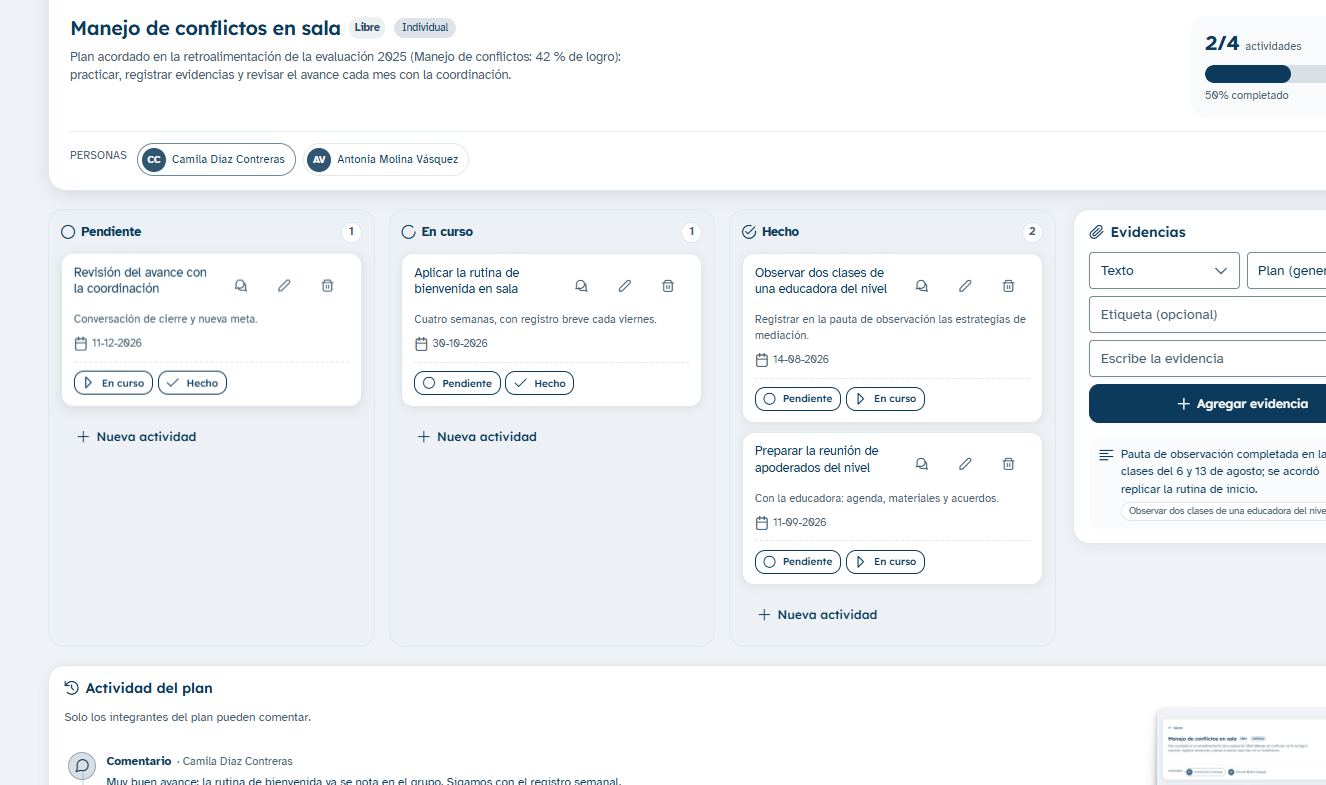
The report is not the end. What changes the work is the feedback between the person and their manager, and the plan that comes out of it.
[TO CONFIRM: how the school does feedback and what has worked for them.]
Repeating it every year is what gives it value
A single process is a snapshot. Several years in a row show a trajectory: what improved, what is still pending and where to put the training.

The numbers
[TO CONFIRM WITH THE SCHOOL before publishing: how many people take part, how many processes they have run and what share completes their evaluation.]
In their words
[TO CONFIRM: a quote from someone at the school, with name and position, authorized in writing.]
What stayed in Eleva thanks to that work
[TO CONFIRM: two or three things in the platform that came from their experience.]
What we learned with schools like Santa Cruz de Chicureo is what we now offer any organization: jobs with their evaluation form, a 360° process repeated every year and results that end in a conversation.