
Blog/ improvement plans
What each team needs to improve: how to decide with evidence
Training plans are usually built on intuition or on whatever courses are on offer. A well-run evaluation shows what each team needs and lets you track whether it improved. What your organization finds in Eleva.
Every year organizations decide what to train their people in. And they almost always decide blind: last year's course is repeated, the usual supplier's course is taken, or the manager who asked most insistently gets attention. At the end of the year nobody can say whether it helped.
The problem: decisions are made on impressions
What a team needs to improve is not obvious. A manager sees the problems that reach them, not the ones the team solves or hides. Without data, the diagnosis is the opinion of whoever speaks loudest, and two areas with the same problem get different answers.
Why it matters
- The training budget is scarce. Spending it where it is not needed means leaving real needs unmet.
- An improvement that is not tracked does not happen. Without a goal and without evidence of progress, the plan stays on paper.
- People cooperate when they understand. It is easier to accept that something needs to improve when the data comes from several people and not from one judgement.
What it takes
- Results by team and by competency, not just one score per person.
- Backing: a low or a high evaluation should be something you can support.
- A plan with a goal, people responsible and deadlines.
- Follow-up: knowing what was done and what changed in the next evaluation.
What you find in Eleva
The diagnosis of each team
The results of a process are shown by team and by competency. You can see clearly where a team is strong and where its gap is, and compare it with the rest of the organization.

Evaluations with backing
Whoever evaluates can attach evidence to their answers: a photograph, a document. An evaluation stops being just an opinion and gains support, for the person who receives it and for the person who reviews it.
From the gap to the plan
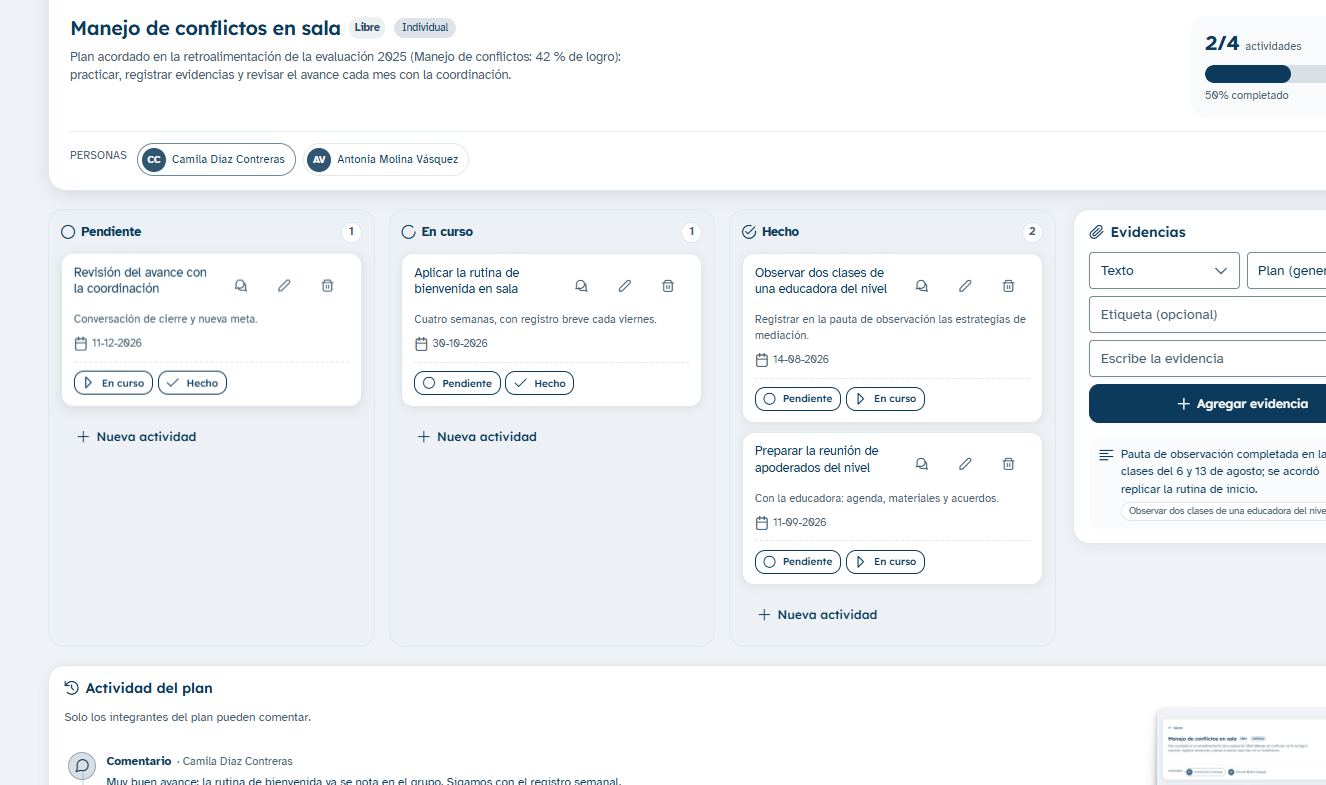
The weakest area of a person or a team suggests the goal of their improvement plan. The plan has activities, people responsible and dates, and each activity can be closed with its evidence.
The manager's follow-up
Each manager sees their team's plans and their progress. There are no reports to request: it is plain to see who is on track and who is not.
Proof that it worked
In the next process, the same competency is measured again. The organization sees whether the gap closed.
What changes
- The training plan is built on the real gaps of each team.
- Difficult conversations rest on evidence and not on perceptions.
- The following year you can show what improved, with data.