Blog/ Start-Up Chile
The day Start-Up Chile said yes
In July 2022 Eleva was selected for the Ignite 4 generation of Start-Up Chile. What we felt that day, and what the mentoring taught us: how to package what we knew how to do.
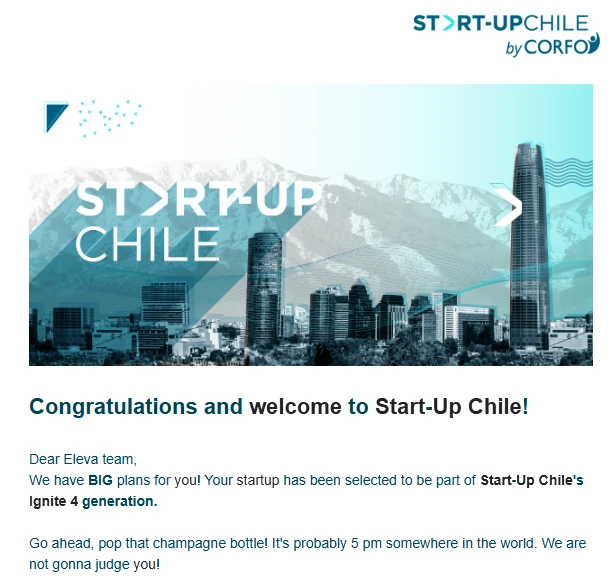
Some emails you never delete. Ours arrived in July 2022 and opened like this: «Congratulations and welcome to Start-Up Chile!». Eleva had been selected for the Ignite 4 generation of Corfo's program, and that day we were very happy.
«Your startup has been selected to be part of Start-Up Chile's Ignite 4 generation.»
What that yes meant
A program like Start-Up Chile betting on Eleva confirmed something we had been saying: a school's performance evaluation can be much more than a yearly formality, and doing it well should not depend on having a large HR team.
The email said it with humor: go ahead and pop the champagne, it is probably 5 pm somewhere in the world. It did not take much convincing. It was a day of celebration for the whole team.
What we learned from the mentoring
Being selected was the beginning. The most valuable part came later, in the program's mentoring sessions, which asked us a question we had been avoiding: what exactly do we deliver? Knowing how to evaluate a school's people well is not the same as having a product another school can understand, buy and use.
That question pushed us to package our solution. In practice, it meant deciding:
- What a school receives. The profile and the rubric of each role, made by specialists and ready to use.
- How the cycle works. The same for everyone: evaluate with the views each role has, talk the results through, and end with an improvement plan.
- How to get started. With clear steps, and with the school reviewing and deciding at each one.
That is how the method we still work with took shape. It is not a list of questions: it is an orderly way to go through the evaluation cycle, with clear rules about who evaluates whom, with which rubric and when.
Four years later
That work of packaging is what allowed this year's step: adding AI agents to Eleva without letting them improvise. Because the method already existed, the assistant does not have to invent how to evaluate; it works on the same rules the platform uses. We tell that story in An AI assistant that doesn't improvise: why ours is deterministic.
To Start-Up Chile and Corfo, thank you for that yes. And to those who mentored us, thank you for the uncomfortable questions: they are still the ones we ask ourselves before building something new.